Santa Fe
Institute
  • Research
    • Themes
    • Projects
    • SFI Press
    • Researchers
    • Publications
    • Library
    • Sponsored Research
    • Fellowships
    • Miller Scholarships
  • News + Events
    • News
    • Newsletters
    • Podcasts
    • SFI in the Media
    • Media Center
    • Events
    • Community
    • Journalism Fellowship
  • Education
    • Programs
    • Projects
    • Alumni
    • Complexity Explorer
    • Education FAQ
    • Postdoctoral Research
    • Education Supporters
  • People
    • Researchers
    • Fractal Faculty
    • Staff
    • Miller Scholars
    • Trustees
    • Governance
    • Resident Artists
    • Research Supporters
  • Applied Complexity
    • Office
    • Applied Projects
    • ACtioN
    • Applied Fellows
    • Studios
    • Applied Events
    • Login
  • Give
    • Give Now
    • Ways to Give
    • Contact
  • About
    • About SFI
    • Engage
    • Complex Systems
    • FAQ
    • Campuses
    • Jobs
    • Contact
    • Library
    • Employee Portal

Science for a Complex World

Events

Here's what's happening

Give

You make SFI possible

Subscribe

Sign up for research news

Connect

Follow us on social media

© 2026 Santa Fe Institute. All rights reserved. This site is supported by the Miller Omega Program.

Home / Events

On the art of giving the same name to different things

Noyce Conference Room
Colloquium
12:30 pm – 1:30 pm  US Mountain Time
March 23, 2022
Speaker: 
Emily Riehl (Johns Hopkins University)

On the art of giving the same name to different things

Tune in for the live stream on YouTube or Twitter.

Abstract: Mathematics has developed an increasingly "higher dimensional" point of view of when different things deserve the same name, categorifying the traditional logical notion of equality to isomorphism (from Greek ἴσος isos "equal" and μορφή morphe "form" or "shape") and equivalence (from Latin aequus "equal" and valere "be well, be worth"). In practice, mathematicians tend to become more flexible in determining when different things deserve the same name as those things become more complicated, as measured by the dimensions of the categories to which they belong. Unfortunately, these pervasive notions of sameness no longer satisfy Leibniz's identity of indiscernibles - the assertion that two objects are identical just when the share the same properties - essentially because the traditional set theoretical foundations of mathematics make it too easy to formulate "evil" statements. However, in a new proposed foundation system there are common rules that govern the meaning of identity for mathematical objects of any type that allow one to "transport" information along any identification. Moreover, as a consequence of Voevodsky's univalence axiom, these identity types are faithful to the meanings of sameness that have emerged from centuries of mathematical practice.


Speaker
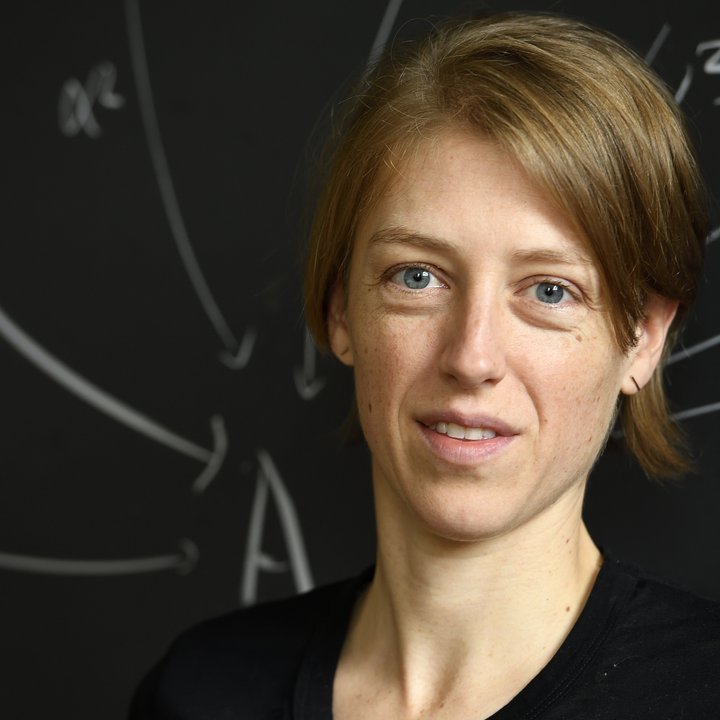
Emily RiehlEmily RiehlProfessor, Mathematics, Johns Hopkins University
SFI Host: 
Andres Ortiz-Muñoz
View more details
Share
  • Sign Up For SFI News
  • SFI Calendars
  • Science


  • SFI Projects
  • Algorithmic justice
  • Artificial intelligence: Foundations to frontiers
  • A theory of embodied intelligence
Show more

  • SFI Themes
  • Complex Intelligence: Natural, Artificial, and Collective
  • Complexity and History
  • Complex Time - Adaptation, Aging, Arrow of Time
Show more

More SFI Events

View All Events
November 12, 2026

Cumulative Culture, Ideas, and Growth from Prehistory to Present

October 8, 2026

Canceled

The Conversational Nature of Language

September 3, 2026

Do LLMs Understand? How Would We Know if They Did? How Can We Get Them To?

August 20, 2026

Seminar - Alec Nevala-Lee

August 13, 2026

Seminar - Sam Bowles

August 11, 2026

Self-organization, Infectious Disease, and Social Behavior - An Evolutionary Tale?

August 10, 2026

Complex Political Identity

July 22, 2026

Twenty Years of Neuroeconomics

July 20, 2026

Simple Models of Complex Phenomena in the Natural and Social Sciences

July 20, 2026

Advances in Archaeoecology

June 24, 2026

Seminar - Madan Rao

June 17, 2026

Seminar - Venkat Viswanathan

June 16, 2026

Emergent Coexistence in Ecological Communities

June 11, 2026

Persuasion at Scale: Machine Learning, Causality, and the Information Ecosystem (Lessons Learned)

June 10, 2026

Seminar - Tania Lombrozo

June 9, 2026

Theories of neural computation underlying learning, imagination and reasoning: of mice, monkeys and machines

June 8, 2026

AI and Justice

June 3, 2026

How Narrative Can, and Can't, or Can't Easily, Communicate Complexity

May 27, 2026

Geometry Guides Generalization in Zero-shot Learning of Dynamical Systems

May 26, 2026

Symbolic Language, Embodied Worlds: Multimodal Intelligence in Humans and Machines

May 19, 2026

Disordered Systems for Neurocomputation

May 14, 2026

Computational Materials Design for Nanoelectronics and Spintronics

May 13, 2026

Navigating the Quantum Complexity of Matter: Computational Frontiers for Quantum Materials

May 12, 2026

The Whole Ocean was Full of Lines, Points, Fields, Waves, Folds: Sharks, Vision, and Transit

May 11, 2026

Computational Frontiers in Quantum Materials

May 11, 2026

Your Data Will Be Used Against You

May 7, 2026

The Geometry of Persuasion: Quantifying Belief Change in a Latent Embedding Space

May 5, 2026

Synchronize or Hop: Two Mechanisms for Predicting the Dynamical World in Modern ML Models

May 4, 2026

Interspecies: Decoding, Translation, and Interpretation

May 4, 2026

The AI - Agency Paradox: How Gains in Human Agency from AI Use Can Deceive Us and How We Can Measure Agency in this New Paradigm

April 30, 2026

Sieving Through Complexity: How Transient Dynamics Emerge from the Finite Observer-Referenced Framework

April 29, 2026

Metacognitive Intelligence in Human-AI Teams

April 28, 2026

Trade, Borrow, or Steal: How Acquired Metabolism Drives Evolutionary Innovation

April 27, 2026

Enhancing Counterfactual Reasoning for Complex Environments

April 24, 2026

Complexity Futures: New Paradigms 2026

April 23, 2026

Disturbance and Recovery Dynamics in Complex Systems

April 22, 2026

Sleep as a Trojan Horse (to find a unifying computational principle central to biological computation)

April 20, 2026

Canceled

Beliefs, Biases and Ballots: A Bayesian Exploration of Mismatch Between Community Preference and Voting Behavior

April 16, 2026

Cognitive Representations of Social Networks

April 14, 2026

How to Model the Mind Simultaneously Across the Computational, Algorithmic, and Neural Levels