WELCOME!
"The purpose of abstraction is not to be vague, but to create a new semantic level in which one can be absolutely precise"—Edsger Dijkstra
"I live on Earth at present, and I don’t know what I am. I know that I am not a category. I am not a thing — a noun. I seem to be a verb, an evolutionary process – an integral function of the universe."—Buckminster Fuller
"It from bit. Otherwise put, every it — every particle, every field of force, even the spacetime continuum itself — derives its function, its meaning, its very existence entirely — even if in some contexts indirectly — from the apparatus elicited answers to yes or no questions, binary choices [52], bits."—J.A. Wheeler, Information, Physics, Quantum: The Search for Links
"The perception of similarity is in every case bound to an instantaneous flash. It slips past, can possibly be regained, but really cannot be held fast, unlike other perceptions. It offers to the eye as fleetingly and transitorily as a constellation of stars. The perception of similarity thus seems to be bound to a time moment (Zeitmoment)."—Walter Benjamin, Doctrine of the Similar (1933)
"Observation supplies fact. Induction ascends from fact to law. Deduction, applying the pure logic of mathematics, reverses the process and descends from law to fact. The facts of observation are liable to the uncertainties and inaccuracies of the human senses and the first inductions of law are rough approximations to the truth. The law is freed from the defects of observation and converted by the speculations of the geometer into exact form. But it has ceased to be pure induction, and has become ideal hypothesis. Deductions are made from it with syllogistic precision, and consequent facts are logically evolved without immediate reference to the actual events of Nature. If the results of computation coincide, not merely qualitatively but quantitatively, with observation, the law is established as a reality, and is restored to the domain of induction."—C.S. Pierce
“One particular talent stands out among the world-class programmers I’ve known—namely, an ability to move effortlessly between different levels of abstraction.”—Donald Knuth [not only true of the best programmers!]
"No modification of the laws of physics is needed to understand the common now of a group of IGUSes as has sometimes been suggested [14]. The common nows of IGUSes meeting the above contingencies will coincide approximately with constant time surfaces in any inertial frame in which they are approximately at rest. But these frames are not singled out by the laws of physics. Indeed, the experimental evidence against preferred frames is special relativity is extraordinarily good [9]. Rather the frames are singled out by the particular situations of the IGUSes themselves."—Jim Hartle, The Physics of Now.
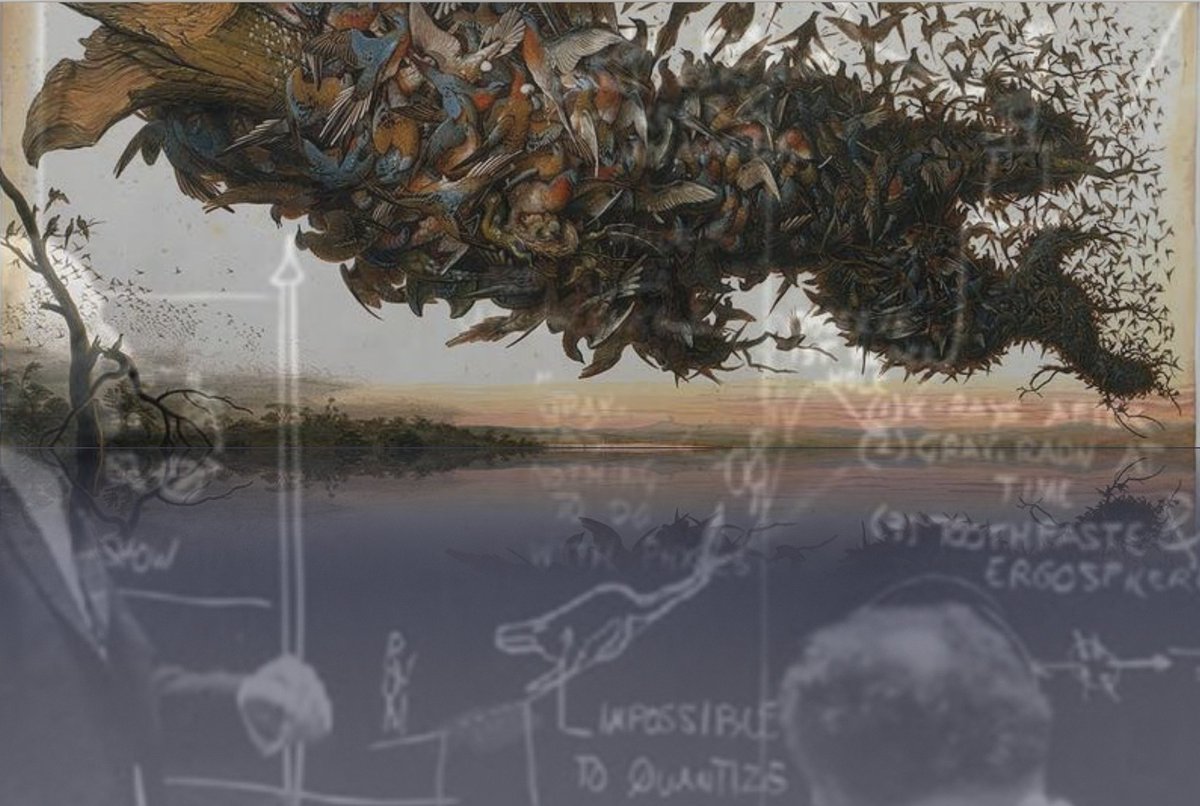
Image: John Wheeler at a Princeton Backboard discussing what in nature can be quantized, but as if he were looking at Walton Ford's painting, "Falling Bough"—a fantastic depiction of collective behavior. Composite by Jessica C. Flack.