Like art and theological thinking, mathematics and other human endeavors are areas of human behavior that confer no apparent evolutionary advantage, require extreme concentration, and stretch the limits of human mental abilities.
Of these three, only mathematics can be studied in a way that allows different cultures and times to be compared on equal footing, providing an opportunity to study the limits of the mind’s capabilities independent of the accidents of history. Mathematical proof dates back at least to Euclid in 300 BCE, and yet little is known about what happens in the mind when humans solve proofs.
An SFI working group titled “Proofs and Reasons: Toward a Cognitive Science of Real Mathematics” gathers Oct. 13–15, 2026, to study just that. The meeting will explore what it means to understand advanced mathematics and mathematical proofs.
 |
|
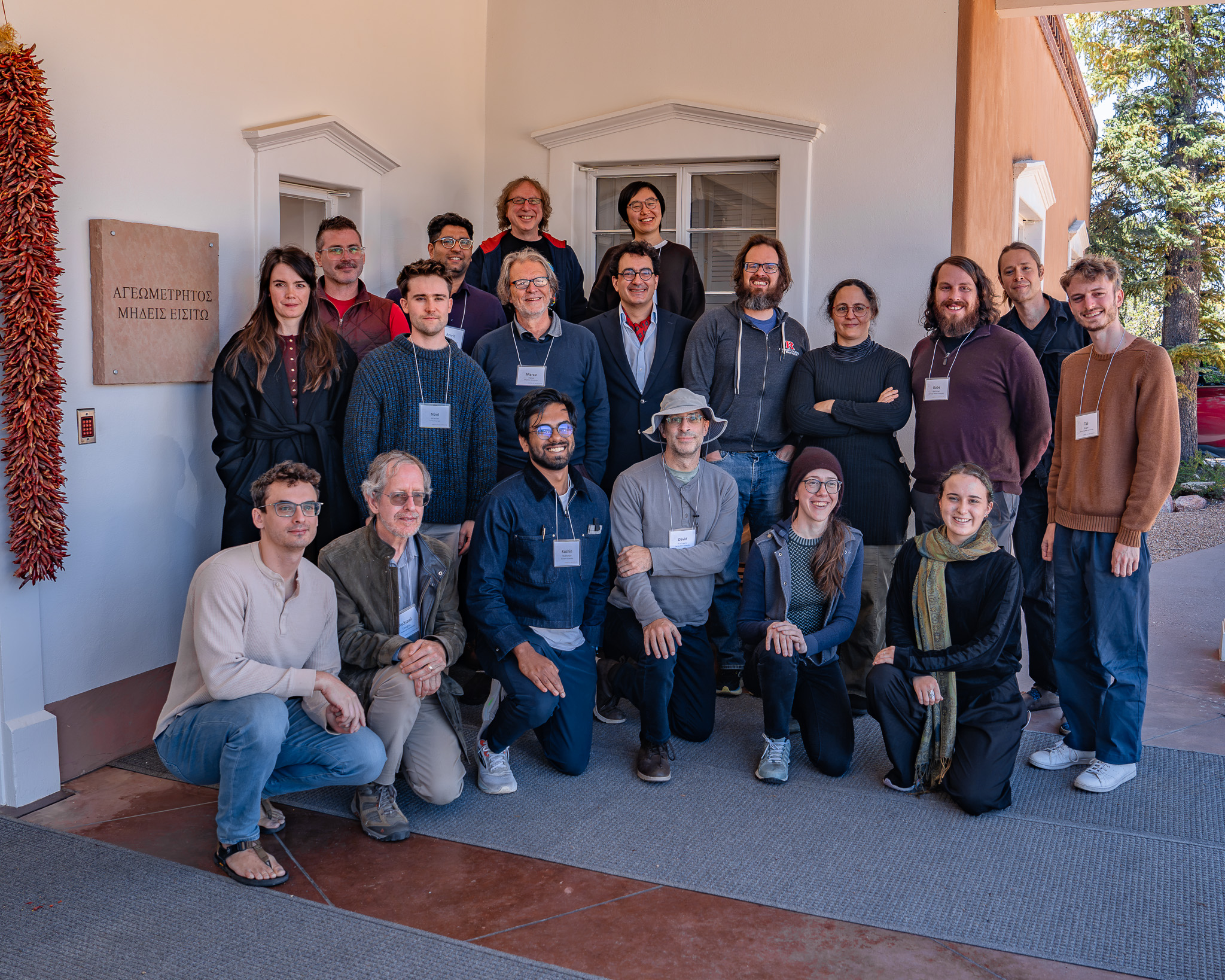
Participants from the SFI working group |
The working group comes at a watershed moment in mathematics. “Three years ago, machines were proving theorems in undergraduate textbooks,” explains SFI External Professor Simon DeDeo (Carnegie Mellon University), one of the meeting’s organizers. “Now machines are proving theorems that we used to consider to be at the absolute outer edge of human possibility.”
Once a proof has been solved, whether by humans or machines, other mathematicians must work to understand the solution. But it’s unclear how AI’s mathematics will overlap with human cognition. As AI systems tackle increasingly advanced problems, researchers want to understand how machines approach the problems and to what extent their results will be accessible to humans.
Mathematicians, cognitive scientists, computer scientists, and philosophers will gather at the working group to explore the cognitive science of how humans discover and make sense of mathematical proofs, the formal study of mathematical proof itself, and the use of AI to discover and verify proofs.
DeDeo says these themes include many open questions, creating an exciting area for study. This is the first of three planned meetings, which DeDeo hopes will lead to a special issue of scientific, philosophical, and mathematical papers on a connected set of questions. “We think we’re in a position to kick off a new area of scientific research,” he says.
This meeting was funded in part by Grant 63750, “Explaining Universal,” from the John Templeton Foundation.